
B2B material supply
Development and supply of silicon–carbon anode powders and engineered active materials to cell manufacturers and strategic customers.
Investors & Partners
This page sets out why we think that is true, what we are building, how it could reach a market, and what could go wrong. The last part matters as much as the first.
Value creation
Each gate answers a harder commercial question. Can the material be repeated? Does a qualified customer want it? Will that customer fund evaluation? Can both teams develop it toward qualification?
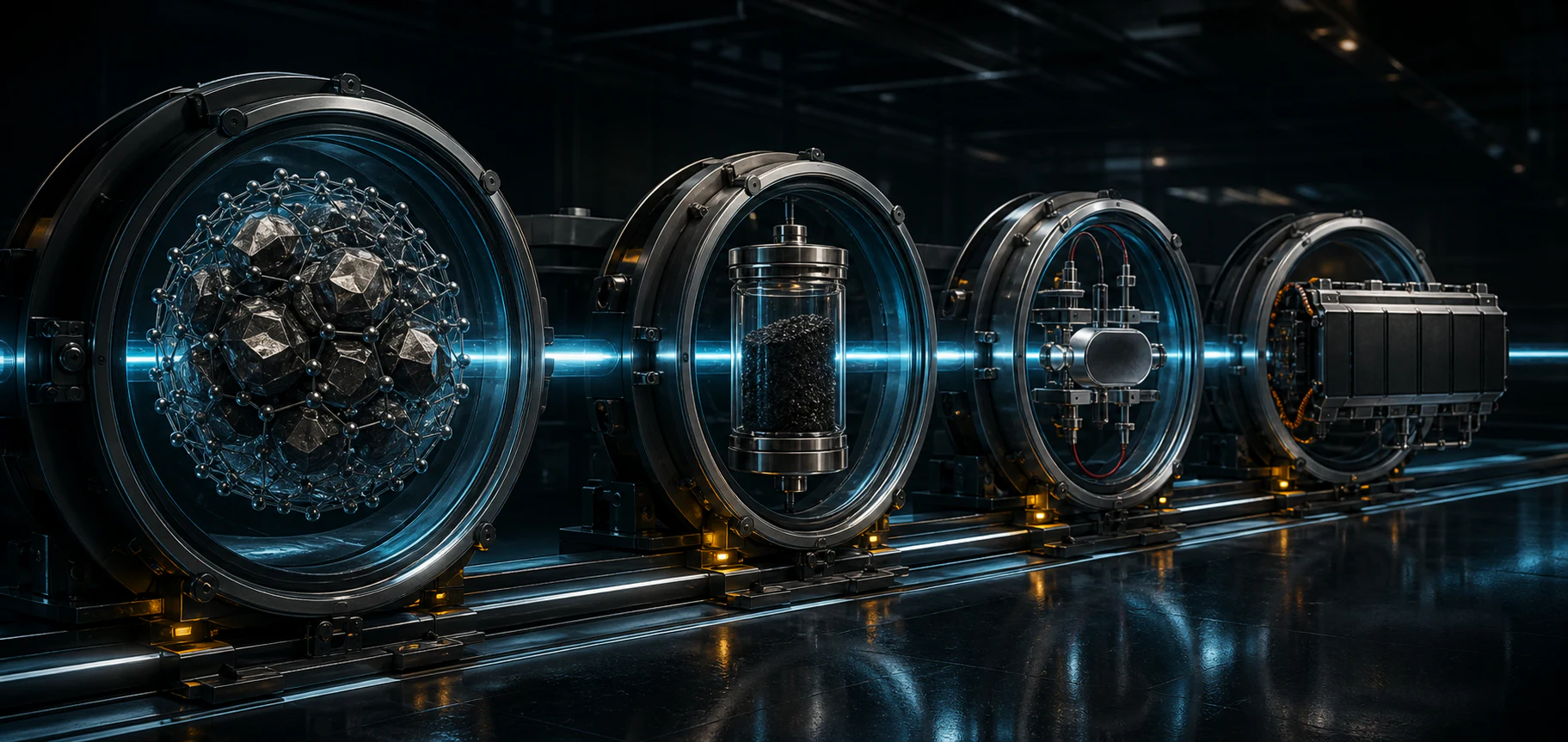
Material qualification reactor
One material. Four de-risking gates.
Current position / G1
G1
Repeatable material
G2
Requested sample
G3
Funded evaluation
G4
Joint development
Commercial proof
The first commercial objective is not a headline valuation. It is a sequence of increasingly credible signals that connects repeatable material to paid customer work.
A repeatable material and electrode process supported by traceable bench data.
A qualified cell developer asks to evaluate a sample against an explicit use case.
A partner funds structured testing, adaptation, and technical support around its cell platform.
The material and electrode are co-developed toward qualification, scale-up, and supply or licensing.
Silic Tech is pre-revenue. It has no announced contracts, letters of intent, grants, or external funding. Reproducible material is the current G1 focus.
Thesis
Electrification of transport, grid storage, and aerospace are all pulling in the same direction: more stored energy per unit of mass and volume.
At 372 mAh/g theoretical capacity, incremental graphite optimisation returns less each year. The constraint is the material, not the engineering around it.
Roughly ten times the theoretical capacity, from an abundant element already familiar to industrial supply chains.
Silicon's capacity is not in question. Its survival under repeated ~300% volume change is. That is a materials-architecture problem.
A carbon architecture engineered to absorb expansion, hold electrical contact, and stabilise the interface.
A material intended to run on existing electrode lines faces a materially shorter path to qualification than one requiring new plant.
Market
Silicon–carbon anode materials are early. The figures below come from preliminary third-party market research and have not yet been independently verified by us.
Defensibility
We hold no granted patents and make no patent-pending claim. What follows is where we believe defensible advantage accumulates in this category, and where our development effort is directed.
Intellectual-property strategy is under development. We describe our position as process know-how and materials-design expertise, because that is what it currently is.
Commercial pathways
These are not four separate businesses. They are staged options on the same underlying material platform, and which one leads depends on who moves first with us.
Development and supply of silicon–carbon anode powders and engineered active materials to cell manufacturers and strategic customers.
Co-development programmes with battery manufacturers, automotive companies, electronics companies, or strategic material partners.
Licensing of selected material architectures, processing methods, or production approaches where commercially appropriate.
Partnerships spanning scale-up, validation, pilot manufacturing, raw-material supply, cell integration, and market deployment.
Roadmap
We do not publish projected dates or completion percentages. Milestones appear here once they are reached and can be substantiated.
Material
Validation
Scale
Commercial
Risk
Any investor who has looked at silicon anodes before already knows this list. Publishing it is not a weakness; omitting it would be.
Silicon-anode degradation is a well-studied and genuinely hard problem. Many credible approaches have not reached commercial durability.
Material behaviour at gram scale does not automatically reproduce at tonne scale. Process repeatability is an open engineering question.
Cell manufacturers and automotive OEMs run multi-year qualification programmes. Adoption is slow by design, for good reason.
Several well-capitalised companies are pursuing silicon anodes with substantial funding and pilot capacity already in place.
We are a development-stage company with no revenue, no funding round announced, and no commercial contracts. What we have is a clear technical thesis and three co-founders whose experience spans battery science, industrial IP, manufacturing discipline, and customer qualification.
Detailed technical data, test methodology, and development status are available to serious counterparties under a confidentiality agreement.